History Is Repeating Itself Once Again

Mark Twain: "a favorite theory of mine [is] that no occurrence is sole and solitary, but is but a repetition of a thing which has happened before, and perhaps ofttimes."[one]
Historic recurrence is the repetition of similar events in history.[a] [b] The concept of historic recurrence has variously been applied to the overall history of the earth (eastward.k., to the rises and falls of empires), to repetitive patterns in the history of a given polity, and to any two specific events which comport a striking similarity.[iv]
Hypothetically, in the extreme, the concept of historic recurrence assumes the form of the Doctrine of Eternal Recurrence, which has been written near in various forms since artifact and was described in the 19th century by Heinrich Heine[c] and Friedrich Nietzsche.[d]
While it is often remarked that "history repeats itself", in cycles of less than cosmological duration this cannot exist strictly truthful.[east] In this interpretation of recurrence, as opposed perhaps to the Nietzschean interpretation, at that place is no metaphysics. Recurrences take place due to ascertainable circumstances and bondage of causality.[f] An example is the ubiquitous phenomenon of multiple contained discovery in scientific discipline and technology, described by Robert Yard. Merton and Harriet Zuckerman. Indeed, recurrences, in the course of reproducible findings obtained through experiment or observation, are essential to the natural and social sciences; and, in the course of chance observations rigorously studied via the comparative method, are essential to the humanities.
Grand.Due west. Trompf, in his book The Idea of Historical Recurrence in Western Idea, traces historically recurring patterns of political thought and behavior in the west since antiquity.[10] If history has lessons to impart, they are to be found par excellence in such recurring patterns.
Historic recurrences of the "hit-similarity" type tin can sometimes induce a sense of "convergence", "resonance" or déjà vu.[g]
[edit]

Aboriginal western thinkers who had thought about recurrence had largely been concerned with cosmological rather than historic recurrence (meet "eternal return", or "eternal recurrence").[eleven] Western philosophers and historians who take discussed various concepts of historic recurrence include the Greek Hellenistic historian Polybius (ca 200 – ca 118 BCE), the Greek historian and rhetorician Dionysius of Halicarnassus (c. sixty BCE – after 7 BCE), Luke the Evangelist, Niccolò Machiavelli (1469–1527), Giambattista Vico (1668–1744), Arnold J. Toynbee (1889–1975).[four]
An eastern concept that bears a kinship to western concepts of historic recurrence is the Chinese concept of the Mandate of Heaven, by which an unjust ruler will lose the support of Heaven and be overthrown.[12]
G.W. Trompf describes various historic paradigms of celebrated recurrence, including paradigms that view types of large-scale historic phenomena variously as "cyclical"; "fluctuant"; "reciprocal"; "re-enacted"; or "revived".[thirteen] He also notes "[t]he view proceeding from a belief in the uniformity of human nature [Trompf'south emphasis]. Information technology holds that because human nature does non modify, the same sort of events can recur at any fourth dimension."[14] "Other pocket-size cases of recurrence thinking," he writes, "include the isolation of any two specific events which bear a very striking similarity [his emphasis], and the preoccupation with parallelism [his emphasis], that is, with resemblances, both general and precise, between carve up sets of historical phenomena."[xiv]
Lessons [edit]
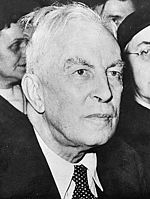
G.W. Trompf notes that most western concepts of historic recurrence imply that "the past teaches lessons for... future action"—that "the aforementioned... sorts of events which accept happened before... volition recur..."[15] 1 such recurring theme was early offered by Poseidonius (a Greek polymath, native to Apamea, Syrian arab republic; ca 135–51 BCE), who argued that dissipation of the old Roman virtues had followed the removal of the Carthaginian claiming to Rome's supremacy in the Mediterranean globe.[16] The theme that civilizations flourish or fail co-ordinate to their responses to the human and environmental challenges that they confront, would be picked up 2 m years later by Toynbee.[17] Dionysius of Halicarnassus (c. sixty BCE – after 7 BCE), while praising Rome at the expense of her predecessors[h]—Assyria, Media, Persia, and Republic of macedonia—anticipated Rome's eventual decay. He thus implied the thought of recurring decay in the history of globe empires—an thought that was to exist developed by the Greek historian Diodorus Siculus (1st century BCE) and past Pompeius Trogus, a 1st-century BCE Roman historian from a Celtic tribe in Gallia Narbonensis.[19]
Past the late 5th century, Zosimus (also chosen "Zosimus the Historian"; fl. 490s–510s: a Byzantine historian who lived in Constantinople) could see the writing on the Roman wall, and asserted that empires fell due to internal disunity. He gave examples from the histories of Greece and Republic of macedonia. In the case of each empire, growth had resulted from consolidation against an external enemy; Rome herself, in response to Hannibal's threat posed at Cannae, had risen to great-power status inside a mere five decades. With Rome'southward world dominion, however, elite had been supplanted by a monarchy, which in plough tended to decay into tyranny; subsequently Augustus Caesar, good rulers had alternated with tyrannical ones. The Roman Empire, in its western and eastern sectors, had become a contending ground between contestants for ability, while exterior powers caused an reward. In Rome's decay, Zosimus saw history repeating itself in its general movements.[20]
The ancients adult an enduring metaphor for a polity's evolution, drawing an analogy betwixt an individual human's life bicycle and developments undergone past a body politic: this metaphor was offered, in varying iterations, past Cicero (106–43 BCE), Seneca (c. 1 BCE – 65 CE), Florus (c. 74 CE – ca 130 CE), and Ammianus Marcellinus (between 325 and 330 CE – subsequently 391 CE).[21] This social-organism metaphor, which has been traced dorsum to the Greek philosopher and polymath Aristotle (384–322 BCE),[22] would recur centuries later in the works of the French philosopher and sociologist Auguste Comte (1798–1857), the English philosopher and polymath Herbert Spencer (1820–1903), and the French sociologist Émile Durkheim (1858–1917).[23]
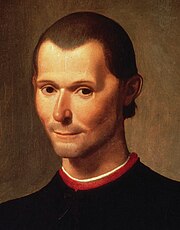
Niccolò Machiavelli, analyzing the country of Florentine and Italian politics between 1434 and 1494, described recurrent oscillations between "order" and "disorder" within states:[24]
when states have arrived at their greatest perfection, they presently begin to decline. In the same mode, having been reduced by disorder and sunk to their utmost state of low, unable to descend lower, they, of necessity, reascend, and thus from good they gradually reject to evil and from evil mount upward to good.[25]
Machiavelli accounts for this oscillation past arguing that virtù (valor and political effectiveness) produces peace, peace brings idleness (ozio), idleness disorder, and disorder rovina (ruin). In turn, from rovina springs order, from society virtù, and from this, glory and good fortune.[26] Machiavelli, as had the aboriginal Greek historian Thucydides, saw homo nature every bit remarkably stable—steady enough for the formulation of rules of political behavior. Machiavelli wrote in his Discorsi:
Whoever considers the by and the present volition readily notice that all cities and all peoples... always have been blithe past the same desires and the aforementioned passions; then that it is easy, by diligent written report of the past, to foresee what is likely to happen in the future in any commonwealth, and to apply those remedies that were used past the ancients, or not finding any that were employed by them, to devise new ones from the similarity of events.[27]
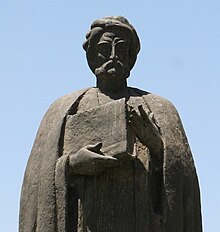
In 1377 the Islamic scholar Ibn Khaldun, in his Muqaddima (or Prolegomena), wrote that when nomadic tribes become united by asabiyya—Standard arabic for "grouping feeling", "social solidarity", or "clannism"—their superior cohesion and armed services prowess puts urban dwellers at their mercy. Inspired often past religion, they conquer the towns and create new regimes. Only within a few generations, writes Ibn Khaldun, the victorious tribesmen lose their asabiyya and become corrupted by luxury, extravagance, and leisure. The ruler, who can no longer rely on tearing warriors for his defense, will have to raise extortionate taxes to pay for other sorts of soldiers, and this in turn may atomic number 82 to further problems that result in the eventual downfall of his dynasty or state.[28] [i]
Joshua Due south Goldstein suggests that empires, analogously to an individual'south midlife crisis, experience a political midlife crisis: after a menstruation of expansion in which all before goals are realized, overconfidence sets in, and governments are and then likely to set on or threaten their strongest rival; Goldstein cites four examples: the British Empire and the Crimean State of war; the German language Empire and the Offset Earth War; the Soviet Matrimony and the Cuban Missile Crunch; the The states and the Vietnam War.[thirty] Suggestions that the European Union is suffering a political midlife crisis have been put forward by Gideon Rachman (2010), Roland Benedikter (2014), and Natalie Nougayrède (2017).
David Hackett Fischer has identified four waves in European history, each of some 150-200 years' duration. Each wave begins with prosperity, leading to inflation, inequality, rebellion and war, and resolving in a long period of equilibrium. For case, 18th-century aggrandizement led to the Napoleonic wars and later the Victorian equilibrium.[31]
Sir Arthur Keith's theory of a species-broad amity-enmity complex suggests that human conscience evolved equally a duality: people are driven to protect members of their in-group, and to hate and fight enemies who vest to an out-group. Thus an endless, useless bicycle of advertisement hoc "isms" arises.[32]
Similarities [edit]
1 of the recurrence patterns identified past G.Westward. Trompf involves "the isolation of any two specific events which behave a very striking similarity".[15] The Castilian-American philosopher George Santayana observed that "Those who cannot remember the past are condemned to echo it."[33] Karl Marx, having in mind the respective coups d'état of Napoleon I (1799) and his nephew Napoleon Three (1851), wrote acerbically in 1852: "Hegel remarks somewhere that all facts and personages of corking importance in world history occur, as it were, twice. He forgot to add: the get-go time as tragedy, the second time every bit farce."[34]
However, Poland's Adam Michnik believes that history is not just about the past because it is constantly recurring, and not equally farce, equally Marx had it, only as itself: "The world", writes Michnik, "is full of inquisitors and heretics, liars and those lied to, terrorists and the terrorized. There is still someone dying at Thermopylae, someone drinking a glass of hemlock, someone crossing the Rubicon, someone drawing up a proscription list."[35]
Plutarch's Parallel Lives traces the similarities betwixt pairs of a Roman and a Greek historical figure.[36]
Poland's Cosmic Primate, Stanisław Szczepanowski, is murdered past his erstwhile friend, King Bolesław the Bold (1079); and England's Catholic Primate, Thomas Becket, is murdered at the behest of his sometime friend, King Henry Ii (1170).
Mongolian Emperor Kublai Khan's attempted conquest of Nihon (1274, 1281) is frustrated by typhoons;[j] and Castilian Male monarch Philip II's 1588 attempted conquest of England is frustrated by a hurricane.
Hernán Cortes's fateful 1519 entry into Mexico's Aztec Empire is reputedly facilitated by the natives' identification of him with their god Quetzalcoatl, who had been predicted to return that very year; and English language Captain James Cook's fateful 1778 entry into Hawaii, during the annual Makahiki festival honoring the fertility and peace god Lono, is reputedly facilitated past the natives' identification of Cook with Lono,[37] who had left Hawaii, promising to render on a floating island, evoked by Melt's ship under total sheet.[38]
On 27 April 1521, Portuguese explorer Ferdinand Magellan, in the Philippine Islands, foolhardily, with but four dozen men, confronts 1,500 natives who have defied his attempt to Christianize them and is killed.[39] On 14 Feb 1779, English explorer James Cook, on Hawaii Isle, foolhardily, with only a few men, confronts the natives subsequently some individuals have taken one of Melt's small boats, and Cook and 4 of his men are killed.[twoscore]
Poland's Queen Jadwiga, dying in 1399, bequeaths her personal jewelry for the restoration of Kraków Academy (which will occur in 1400); and Leland Stanford'southward widow Jane Stanford attempts, after his 1893 decease, to sell her personal jewelry to restore Stanford University's fiscal viability, ultimately bequeathing the jewelry to fund the purchase of books for Stanford University.[k]
In 1812 French Emperor Napoleon – born a Corsican outsider – is unprepared for an extended winter entrada, all the same invades the Russian Empire, precipitating the fall of the French Empire; and in 1941 German Führer Adolf Hitler – built-in an Austrian outsider – is unprepared for an extended winter campaign, yet invades the Russian Empire'due south Soviet successor state (which is ruled by Joseph Stalin, born a Georgian outsider), thus precipitating the autumn of the High german Third Reich.[41]
Mahatma Gandhi works to liberate his compatriots past peaceful means and is shot expressionless; Martin Luther King Jr., works to liberate his compatriots past peaceful ways and is shot expressionless.[42]
Over history, confrontations between peoples – typically, geographical neighbors – help consolidate the peoples into nations, at times into frank empires; until at last, exhausted past conflicts and tuckered of resources, the one time militant polities settle into a relatively peaceful habitus.[43] [50]
Polities ignore Jan Bloch's 1898 warnings of the railroad-mobilized, industrialized, stalemated, attritional total war, World War I, that is on the fashion and will destroy an appreciable function of mankind;[45] and polities ignore geologists', oceanographers', atmospheric scientists', biologists', and climatologists' warnings of the climate-change tipping point that is on grade to destroy all of mankind.[46] [thou]
People ignore warnings about the dangers of nuclear power plants[48] until anticipated nuclear ability-constitute accidents occur; and people ignore warnings nearly the dangers of nuclear weapons[49] [n] [51] until some urban center in the world is blown up by a nuclear weapon.
Jessica Tuchman Mathews, daughter of The Guns of August author Barbara Tuchman, observes that "[P]owerful reasons to uncertainty that there could be a express nuclear war [include] those that emerge from any study of history, a noesis of how humans human action under force per unit area, or feel of government."[52] Apposite evidence for this is provided in Martin J. Sherwin's Gambling with Armageddon, which makes clear, on the basis of recently declassified documents, that it was a thing of sheer chance that war was averted during the Cuban Missile Crisis: numerous events, had they taken a slightly unlike course, could each have precipitated nuclear state of war.[53] [o]

Fintan O'Toole writes nigh American state of war contributor Martha Gellhorn (1908–98):
Her dispatches were not first drafts of history; they were letters from eternity. [...] To run across history – at least the history of state of war – in terms of people is to come across it not every bit a linear process simply as a serial of terrible repetitions [...]. It is her ability to capture [...] the terrible futility of this sameness that makes Gellhorn's reportage and so genuinely timeless. [Westward]e are [...] drawn [...] into the undertow of her distraught sensation that this moment, in its essence, has happened before and will happen again.[55]
Casey Cep, describing a racket between William Faulkner'south documented personal racism and Faulkner's depiction of the American Confederacy, writes that Michael Gorra, in The Saddest Words: William Faulkner's Civil War ([Liveright, 2020),
posits that [the graphic symbol] Quentin [Compson, who suicides in Absalom, Absalom!] represents Faulkner's view of tragedy as recurrence. "Once again" was the saddest give-and-take for the character and the writer alike because it "suggests that what was has simply gone on happening, a bicycle of repetition that replays itself, forever."... "What was is never over," Gorra writes, pointing out that the racism that ensnared Faulkner in the concluding century persists in th[eastward 21st]... "Once again. That'south precisely why Faulkner remains so valuable – that very recurrence makes him necessary."[56]
British novelist Martin Amis observes that recurring patterns of imperial ascendance-and-refuse are mirrored in the novels published; according to Amis, novels follow electric current political trends. In the Victorian era, when Britain was the ascendant ability, British novels were big and tried to express what club equally a whole was. British power waned during the Second World War and ended afterwards the state of war. The British novel was then some 225 pages long and centered on narrower subjects such as career setbacks or marriage setbacks: the British novel's "peachy tradition" increasingly looked depleted. Ascendance, according to Amis, had passed to the U.s.a., and Americans such as Saul Blare, Norman Mailer, Philip Roth, and John Updike began writing huge novels.[57]
Novelists and historians take discerned recurrent patterns in the histories of mod political tyrants.[58]

Gabriel García Márquez, in his novelThe Autumn of the Patriarch (1975), [...] create[d] a blended graphic symbol: a mythical, unnamed autocrat who has held sway, seemingly forever, over an invented Caribbean state akin to Costaguana in Joseph Conrad's Nostromo. To portray him, García Márquez drew upon a motley accomplice of Latin American caudillos [...] as well as Spain's Generalissimo Francisco Franco [...].[59]
Ruth Ben-Ghiat in Strongmen: Mussolini to the Nowadays (2020), writes Ariel Dorfman, documents the "viral recurrence" around the world, over the past century, of despots and authoritarians "with comparable strategies of control and mendacity." Ben-Ghiat divides the narrative into 3 – at times, overlapping – periods:[lx]
The era of fascist takeovers runs from 1919 and the rise of Mussolini until Hitler's defeat in 1945, with Franco equally the tertiary member of this atrocious trio [... In] the next phase, the age of military coups (1950–1990) [t]he chief representatives [...] are Pinochet, Muammar Qaddafi, and Mobutu Sese Seko, along with minor figures like Idi Amin, Saddam Hussein, and Mohamed Siad Barre. Finally, starting in 1990 [is] the [...] bicycle of new authoritarians, who win elections and proceed to degrade the democracy that brought them to power. Ben-Ghiat primarily dissects Silvio Berlusconi, Vladimir Putin, and Donald Trump, with Viktor Orbán, Jair Bolsonaro, Rodrigo Duterte, Narendra Modi, and Recep Tayyip Erdoğan given perfunctory assessments.[61]
Dorfman notes the absenteeism, from Ben-Ghiat's study, of many authoritarian rulers, including communists like Mao, Stalin, Ceaușescu, and the three Kims of North Korea. Nor is there mention of Indonesia'southward Suharto or the Shah of Iran, Mohammad Reza Pahlavi, "though the CIA engineered coups that led to both [...] lording it over their lands, and the bureau tin likewise be linked to Pinochet's military putsch in Republic of chile." Dorfman believes that Juan Domingo Perón would also have been an instructive example to include in Ruth Ben-Ghiat's study of Strongmen.[62]
British political commentator Ferdinand Mount brings attention to the ubiquitous recurrence of mendacity in politics: politicians lie to encompass upwardly their mistakes, to gain advantage over their opponents, or to achieve purposes that might be unpalatable or harmful to their public or to a foreign public. Some notable practitioners of political mendacity discussed by Mountain include Julius Caesar, Cesare Borgia, Queen Elizabeth I, Oliver Cromwell, Robert Clive, Napoleon, Winston Churchill, Tony Blair, Boris Johnson, and Donald Trump,[63]
Run into also [edit]
- Amity-enmity complex
- The Anatomy of Revolution
- Big Bang
- Big Bounciness (pulsating-universe theory)
- Cliodynamics
- Night (TV series)
- Eternal return
- Exceptionalism
- Eureka: A Prose Poem, by Edgar Allan Poe, 1848 (Big Blindside theory)
- Fractal
- Generation Zero
- Is the Holocaust Unique?
- Lest Nosotros Forget
- Listing of multiple discoveries
- List of pre-modern great powers
- Multiple discovery
- Never again
- Peter Turchin
- Philosophy of history
- Political midlife crunch
- Repetition, a related concept past Søren Kierkegaard
- The Ascent and Fall of the Neat Powers
- Societal collapse
- Land collapse
- Strauss-Howe generational theory
- The True Believer
- Thucydides Trap
Notes [edit]
- ^ Marker Twain writes of "a favorite theory of mine—to wit, that no occurrence [Twain's accent] is sole and solitary, but is merely a repetition of a thing which has happened before, and perchance often." (A "repeat occurrence" is the definition of "recurrence".)[1] A similar thought of uncertain attribution has been ascribed to Twain: "History does non echo itself, but it rhymes."[2]
- ^ Herman Melville, in his poetry, "declare[d a] conventionalities... that all history is mere iteration ('Age after historic period shall be/As age after age has been')..."[3]
- ^ Philosopher Walter Kaufmann quotes Heinrich Heine: "[T]ime is infinite, but the things in time, the concrete bodies, are finite. They may indeed disperse into the smallest particles; but these particles, the atoms, have their determinate numbers, and the numbers of the configurations which, all of themselves, are formed out of them are likewise determinate. Now, however long a time may pass, co-ordinate to the eternal laws governing the combinations of this eternal play of repetition, all configurations which accept previously existed on this earth must yet meet, concenter, repulse, kiss, and corrupt each other again..."[5]
- ^ The concept of "eternal recurrence" is central to the writings of Friedrich Nietzsche. Information technology appears in The Gay Scientific discipline and in Thus Spoke Zarathustra, and also in a posthumous fragment. Walter Kaufmann suggests that Nietzsche may have encountered the concept in the writings of Heinrich Heine.[vi]
- ^ Thousand.Due west. Trompf writes: "The thought of exact recurrence... was rarely incorporated into... these views, for in the main they merely presume the recurrence of sorts of events, or... upshot-types, -complexes, and -patterns."[7]
- ^ In 1814 Pierre-Simon Laplace published an early articulation of causal or scientific determinism: "We may regard the present land of the universe as the outcome of its past and the cause of its future. An intellect which at a certain moment would know all forces that fix nature in motion, and all positions of all items of which nature is composed, if this intellect were likewise vast enough to submit these information to analysis, it would cover in a single formula the movements of the greatest bodies of the universe and those of the tiniest cantlet; for such an intellect, nothing would be uncertain and the future, simply like the past, would be present earlier its eyes."[viii] A similar view had before been presented in 1763 by Roger Boscovich.[ix]
- ^ This sense is somewhat suggested, in popular culture, by the moving-picture show Groundhog Twenty-four hours.
- ^ His was thus a quasi-exceptionalist view.[18]
- ^ Toynbee regarded Ibn Khaldun's Muqaddima as "undoubtedly the greatest work of its kind that has e'er been created by any mind in any fourth dimension or place."[29]
- ^ The original kamikaze ("divine wind").
- ^ The Stanford Academy Museum of Art displays a painting of Jane Stanford's jewelry, commissioned prior to the jewelry's predictable auction.
- ^ Victor Bulmer-Thomas writes: "Purple retreat is not the same as national decline, as many other countries can attest. Indeed, majestic retreat can strengthen the nation-state only as royal expansion can weaken information technology."[44]
- ^ On 8 October 2022 the Intergovernmental Panel on Climate Change published a report stating that, if drastic changes in the global free energy base and lifestyle are not fabricated by nearly 2030—within a dozen years—culture on planet Globe volition go unsalvageable.[47]
- ^ Nuclear weapons go along to exist equally hazardous to their owners equally to their potential targets. Under the 1970 Treaty on the Non-Proliferation of Nuclear Weapons, nuclear-weapon states are supposed to piece of work toward the elimination of nuclear weapons from the world.[50]
- ^ I of the many factors that fortuitously combined to avert Armageddon was President Kennedy'south earlier experience involving Republic of cuba: according to Ted Sorensen, afterwards the fiasco of the Bay of Pigs invasion "he was more skeptical of the recommendations which came to him from the experts," well-nigh of whom now brash invading or bombing Cuba.[54]
References [edit]
- ^ a b Mark Twain, The Jumping Frog: In English, Then in French, so Clawed Dorsum into a Civilized Language Once More by Patient, Unremunerated Toil, illustrated by F. Strothman, New York and London, Harper & Brothers, Publishers, 1903, p. 64.
- ^ "History Does Not Repeat Itself, But It Rhymes". Quote Investigator. January 12, 2014.
- ^ Helen Vendler, "'No Poesy You Have Read'" (review of Hershel Parker, ed., Herman Melville: Consummate Poems, Library of America, 990 pp.), The New York Review of Books, vol. LXVI, no. nineteen (v Dec 2019), pp. 29, 32–34. (Quotation from p. 32.)
- ^ a b G.West. Trompf, The Idea of Historical Recurrence in Western Thought, passim.
- ^ Walter Kaufmann, Nietzsche: Philosopher, Psychologist, Antichrist, 1959, p. 276.
- ^ Walter Kaufmann, Nietzsche: Philosopher, Psychologist, Antichrist, 1959, p. 276.
- ^ Thou.W. Trompf, The Idea of Historical Recurrence in Western Thought, p. 3.
- ^ Pierre-Simon Laplace, A Philosophical Essay, New York, 1902, p. four.
- ^ Carlo Cercignani, chapter 2: "Physics before Boltzmann", in Ludwig Boltzmann: The Man Who Trusted Atoms, Oxford University Press, 1998, ISBN 0-xix-850154-4, p. 55.
- ^ Thousand.W. Trompf, The Thought of Historical Recurrence in Western Thought, passim.
- ^ K.W. Trompf, The Idea of Historical Recurrence in Western Thought, pp. half dozen-15.
- ^ Elizabeth Perry, Challenging the Mandate of Heaven: Social Protest and Country Ability in China, Sharpe, 2002, ISBN 0-7656-0444-two, passim.
- ^ G.W. Trompf, The Idea of Historical Recurrence in Western Idea, pp. ii-3 and passim.
- ^ a b G.Due west. Trompf, The Thought of Historical Recurrence in Western Thought, p. 3 and passim.
- ^ a b G.W. Trompf, The Idea of Historical Recurrence in Western Thought, p. iii.
- ^ Grand.Due west. Trompf, The Idea of Historical Recurrence in Western Thought, p. 185.
- ^ Arnold J. Toynbee, A Study of History, 12 volumes, Oxford University Press, 1934–61, passim.
- ^ G.Westward. Trompf, The Idea of Historical Recurrence in Western Idea, p. 192.
- ^ G.Due west. Trompf, The Idea of Historical Recurrence in Western Idea, pp. 186–87.
- ^ G.West. Trompf, The Thought of Historical Recurrence in Western Thought, pp. 187–88.
- ^ G.Westward. Trompf, The Idea of Historical Recurrence in Western Thought, pp. 188–92.
- ^ George R. MacLay, The Social Organism: A Short History of the Idea that a Human Society May Be Regarded as a Gigantic Living Creature, North River Press, 1990, ISBN 0-88427-078-5, passim.
- ^ George R. MacLay, The Social Organism: A Short History of the Idea that a Human Society May Exist Regarded every bit a Gigantic Living Creature, N River Press, 1990, ISBN 0-88427-078-5, passim.
- ^ G.W. Trompf, The Idea of Historical Recurrence in Western Thought, p. 256.
- ^ G.W. Trompf, The Idea of Historical Recurrence in Western Thought, p. 256.
- ^ Thousand.W. Trompf, The Idea of Historical Recurrence in Western Thought, p. 256.
- ^ G.W. Trompf, The Idea of Historical Recurrence in Western Thought, p. 258.
- ^ Malise Ruthven, "The Otherworldliness of Ibn Khaldun" (review of Robert Irwin, Ibn Khaldun: An Intellectual Biography, Princeton University Press, 2018, ISBN 9780691174662, 243 pp.), The New York Review of Books, vol. LXVI, no. 2 (Feb 7, 2019), p. 23.
- ^ Malise Ruthven, "The Otherworldliness of Ibn Khaldun" (review of Robert Irwin, Ibn Khaldun: An Intellectual Biography, Princeton University Printing, 2018, ISBN 9780691174662, 243 pp.), The New York Review of Books, vol. LXVI, no. 2 (February 7, 2019), p. 23.
- ^ Joshua S Goldstein, Long Cycles: Prosperity and War in the Modern Age, 1988, passim.
- ^ David Hackett Fischer, The Peachy Wave: Price Revolutions and the Rhythm of History, Oxford University Press, 1996, passim.
- ^ Arthur Keith, A New Theory of Man Evolution, Watts, 1948, passim.
- ^ George Santayana, The Life of Reason, vol. 1: Reason in Common Sense, 1905.
- ^ The Eighteenth Brumaire of Louis Bonaparte (1852), in Marx Engels Selected Works, volume I, p. 398.
- ^ Paul Wilson, "Adam Michnik: A Hero of Our Fourth dimension," The New York Review of Books, vol. LXII, no. six (April 2, 2015), p. 74.
- ^ James Romm, ed., Plutarch: Lives that Made Greek History, Hackett Publishing, 2012, p. vi.
- ^ Jenny Uglow, "Isle Hopping" (review of Captain James Cook: The Journals, selected and edited by Philip Edwards, London, Folio Social club, three volumes and a chart of the voyages, i,309 pp.; and William Frame with Laura Walker, James Cook: The Voyages, McGill-Queen Academy Printing, 224 pp.), The New York Review of Books, vol. LXVI, no. 2 (February 7, 2019), p. 19 (total review: pp. 18-xx).
- ^ Ross Cordy, Exalted Sits the Chief: The Aboriginal History of Hawai'i Island, Common Publishing, 2000, p. 61.
- ^ "The Death of Magellan, 1521". Eyewitnesstohistory.com. Retrieved xvi November 2010.
- ^ Collingridge, Vanessa (2003). Captain Melt: The Life, Death and Legacy of History's Greatest Explorer. Ebury Printing. ISBN978-0-09-188898-5. , p. 410.
- ^ Englund, Steven (March 2006). "Napoleon and Hitler". Journal of The Historical Gild. 6 (1): 151–169. doi:ten.1111/j.1540-5923.2006.00171.x.
- ^ Morselli, Davide; Passini, Stefano (2010). "Avoiding crimes of obedience: A comparative written report of the autobiographies of M. G. Gandhi, Nelson Mandela, and Martin Luther King, Jr". Peace and Disharmonize: Journal of Peace Psychology. 16 (3): 295–319. doi:10.1080/10781911003773530. ISSN 1532-7949.
- ^ Paul Kennedy, The Rise and Fall of the Bang-up Powers: Economic Change and Military Conflict from 1500 to 2000, New York, Random House, 1987, ISBN 0-394-54674-1, passim.
- ^ Jackson Lears, "Majestic Exceptionalism" (review of Victor Bulmer-Thomas, Empire in Retreat: The Past, Present, and Future of the Us, Yale University Press, 2018, ISBN 978-0-300-21000-2, 459 pp.; and David C. Hendrickson, Republic in Peril: American Empire and the Liberal Tradition, Oxford University Printing, 2017, ISBN 978-0190660383, 287 pp.), The New York Review of Books, vol. LXVI, no. 2 (February 7, 2019), pp. 8-10. (p. 10.)
- ^ Jan Bloch, Future war and its economic consequences, 1898.
- ^ Joshua Busby, "Warming World: Why Climate Modify Matters More Anything Else", Strange Affairs, vol. 97, no. iv (July / August 2018), p. 54.
- ^ Intergovernmental Console on Climate change, Special Report on Global Warming of one.v °C, eight Oct 2018.
- ^ Sheldon Novick, The Careless Atom, Boston, Houghton Mifflin Company, 1969, passim
- ^ Thomas Powers, "The Nuclear Worrier" (review of Daniel Ellsberg, The Doomsday Machine: Confessions of a Nuclear War Planner, New York, Bloomsbury, 2017, ISBN 9781608196708, 420 pp.), The New York Review of Books, vol. LXV, no. ane (eighteen January 2018), pp. 13–fifteen.
- ^ Eric Schlosser, Control and Control: Nuclear Weapons, the Damascus Accident, and the Illusion of Rubber, Penguin Press, 2013, ISBN 1594202273. The book became the basis for a ii-hour 2022 PBS American Experience episode, likewise titled "Command and Control".
- ^ Laura Grego and David Wright, "Broken Shield: Missiles designed to destroy incoming nuclear warheads neglect frequently in tests and could increment global hazard of mass devastation", Scientific American, vol. 320, no. no. half dozen (June 2019), pp. 62–67.
- ^ Jessica T. Mathews, "The New Nuclear Threat", The New York Review of Books, vol. LXVII, no. thirteen (twenty August 2020), pp. nineteen–21. (Quotation from p. 20.)
- ^ Elizabeth Kolbert, "This Shut; The mean solar day the Cuban missile crisis almost went nuclear" (a review of Martin J. Sherwin's Gambling with Armageddon: Nuclear Roulette from Hiroshima to the Cuban Missile Crunch, New York, Knopf), The New Yorker, 12 Oct 2020, pp. 70–73.
- ^ Elizabeth Kolbert, "This Close; The twenty-four hour period the Cuban missile crisis virtually went nuclear" (a review of Martin J. Sherwin'due south Gambling with Armageddon: Nuclear Roulette from Hiroshima to the Cuban Missile Crisis, New York, Knopf), The New Yorker, 12 October 2020, p. 72.
- ^ Fintan O'Toole, "A Moral Witness" (review of Janet Somerville, ed., Yours, for Probably Always: Martha Gellhorn's Letters of Love and War, 1930–1949, Firefly, 528 pp.), The New York Review of Books, vol. LXVII, no. 15 (eight Oct 2020), pp. 29–31. (Quotation, p. 31.)
- ^ Casey Cep, "Demon-driven: The bigoted views and brilliant fiction of William Faulkner", The New Yorker, 30 Nov 2020, pp. 87–91. (Quotation: p. ninety.)
- ^ Sam Tanenhaus, "The Electroshock Novelist: The Alluring Bad Boy of Literary England Has Always Been Fascinated by Britain's Dustbin Empire. Now Martin Amis Takes On American Backlog," Newsweek, July 2 & 9, 2012, p. 52.
- ^ Ariel Dorfman, "A Taxonomy of Tyrants" (review of Ruth Ben-Ghiat, Strongmen: Mussolini to the Nowadays, Norton, 2020, 358 pp.), The New York Review of Books, vol. LXVIII, no. 9 (27 May 2021), pp. 25–27.
- ^ Ariel Dorfman, "A Taxonomy of Tyrants" (review of Ruth Ben-Ghiat, Strongmen: Mussolini to the Present, Norton, 2020, 358 pp.), The New York Review of Books, vol. LXVIII, no. ix (27 May 2021), pp. 25–27. (Quotation, p. 25.)
- ^ Ariel Dorfman, "A Taxonomy of Tyrants" (review of Ruth Ben-Ghiat, Strongmen: Mussolini to the Present, Norton, 2020, 358 pp.), The New York Review of Books, vol. LXVIII, no. 9 (27 May 2021), pp. 25–27. (P. 25.)
- ^ Ariel Dorfman, "A Taxonomy of Tyrants" (review of Ruth Ben-Ghiat, Strongmen: Mussolini to the Present, Norton, 2020, 358 pp.), The New York Review of Books, vol. LXVIII, no. 9 (27 May 2021), pp. 25–27. (Quotation, p. 25.).
- ^ Ariel Dorfman, "A Taxonomy of Tyrants" (review of Ruth Ben-Ghiat, Strongmen: Mussolini to the Nowadays, Norton, 2020, 358 pp.), The New York Review of Books, vol. LXVIII, no. 9 (27 May 2021), pp. 25–27. (P. 26–27.)
- ^ * Ferdinand Mount, "Ruthless and Truthless" (review of Peter Oborne, The Assail on Truth: Boris Johnson, Donald Trump and the Emergence of a New Moral Barbarism, Simon and Schuster, February 2021, ISBN 978 1 3985 0100 3, 192 pp.; and Colin Kidd and Jacqueline Rose, eds., Political Communication: By, Nowadays and Future, I.B. Tauris, Feb 2021, ISBN 978 1 83860 004 four, 240 pp.), London Review of Books, vol. 43, no. ix (6 May 2021), pp. 3, 5–8.
Bibliography [edit]
- Casey Cep, "Demon-driven: The bigoted views and brilliant fiction of William Faulkner", The New Yorker, 30 November 2020, pp. 87–91.
- Carlo Cercignani, chapter 2: "Physics before Boltzmann", in Ludwig Boltzmann: The Man Who Trusted Atoms, Oxford Academy Press, 1998, ISBN 0-nineteen-850154-4.
- David Christian, Maps of Fourth dimension: an Introduction to Big History, Academy of California Press, 2005.
- Jared Diamond, Guns, Germs, and Steel: the Fates of Man Societies, new ed., Due west.Due west. Norton, 2005.
- Ariel Dorfman, "A Taxonomy of Tyrants" (review of Ruth Ben-Ghiat, Strongmen: Mussolini to the Present, Norton, 2020, 358 pp.), The New York Review of Books, vol. LXVIII, no. ix (27 May 2021), pp. 25–27.
- The Eighteenth Brumaire of Louis Bonaparte (1852), in Marx Engels Selected Works, book I.
- Niall Ferguson, Civilization: The West and the Rest, Penguin Press, 2011.
- Niall Ferguson, "America'south 'Oh Sh*t!' Moment," Newsweek, November 7 & 14, 2011, pp. 36–39.
- David Hackett Fischer, The Great Wave: Price Revolutions and the Rhythm of History, Oxford Academy Printing, 1996.
- Joshua Southward Goldstein, Long Cycles: Prosperity and War in the Modern Age, 1988.
- Gordon Graham, "Recurrence," The Shape of the By, Oxford University Press, 1997, ISBN 0-19-289255-10.
- Marshall G.S. Hodgson, Rethinking World History: Essays on Europe, Islam, and Earth History, Cambridge University Press, 1993.
- Walter Kaufmann, Nietzsche: Philosopher, Psychologist, Antichrist, 1959.
- Arthur Keith, A New Theory of Man Development, Watts, 1948.
- Paul Kennedy, The Rise and Autumn of the Great Powers: Economic Change and Military Disharmonize from 1500 to 2000, Random Business firm, 1987, ISBN 0-394-54674-1.
- Ibn Khaldun, Muqadimmah, 1377.
- Elizabeth Kolbert, "This Shut; The day the Cuban missile crisis almost went nuclear" (a review of Martin J. Sherwin's Gambling with Armageddon: Nuclear Roulette from Hiroshima to the Cuban Missile Crunch, New York, Knopf, 2020), The New Yorker, 12 October 2020, pp. 70–73.
- Andrey Korotayev, Arteny Malkov, Daria Khaltourina, Introduction to Social Macrodynamics: Secular Cycles and Millennial Trends., Moscow, 2006, ISBN v-484-00559-0. See especially chapter ii.
- David Lamb and Due south.M. Easton, Multiple Discovery: The Pattern of Scientific Progress, Amersham, Avebury Press, 1984.
- Pierre-Simon Laplace, A Philosophical Essay, New York, 1902.
- Jackson Lears, "Royal Exceptionalism" (review of Victor Bulmer-Thomas, Empire in Retreat: The Past, Nowadays, and Hereafter of the Us, Yale University Press, 2018, ISBN 978-0-300-21000-2, 459 pp.; and David C. Hendrickson, Republic in Peril: American Empire and the Liberal Tradition, Oxford University Press, 2017, ISBN 978-0190660383, 287 pp.), The New York Review of Books, vol. LXVI, no. ii (February 7, 2019), pp. 8-10. Bulmer-Thomas writes: "Imperial retreat is not the same every bit national turn down, equally many other countries can attest. Indeed, regal retreat tin can strengthen the nation-land just every bit regal expansion can weaken information technology." (NYRB, cited on p. 10.)
- Robert K. Merton, The Sociology of Science: Theoretical and Empirical Investigations, Academy of Chicago Press, 1973.
- Ferdinand Mount, "Ruthless and Truthless" (review of Peter Oborne, The Assault on Truth: Boris Johnson, Donald Trump and the Emergence of a New Moral Barbarism, Simon and Schuster, February 2021, ISBN 978 ane 3985 0100 3, 192 pp.; and Colin Kidd and Jacqueline Rose, eds., Political Advice: By, Present and Future, I.B. Tauris, February 2021, ISBN 978 1 83860 004 4, 240 pp.), London Review of Books, vol. 43, no. 9 (6 May 2021), pp. 3, 5–8.
- Fintan O'Toole, "A Moral Witness" (review of Janet Somerville, ed., Yours, for Probably Always: Martha Gellhorn'due south Letters of Love and War, 1930–1949, Firefly, 528 pp.), The New York Review of Books, vol. LXVII, no. 15 (8 October 2020), pp. 29–31.
- Elizabeth Perry, Challenging the Mandate of Sky: Social Protest and Land Power in China, Sharpe, 2002, ISBN 0-7656-0444-ii.
- Malise Ruthven, "The Otherworldliness of Ibn Khaldun" (review of Robert Irwin, Ibn Khaldun: An Intellectual Biography, Princeton University Press, 2018, ISBN 9780691174662, 243 pp.), The New York Review of Books, vol. LXVI, no. ii (February seven, 2019), pp. 23–24, 26.
- George Santayana, The Life of Reason, vol. 1: Reason in Common Sense, 1905.
- Pitirim Aleksandrovich Sorokin, Social and Cultural Dynamics: a Study of Modify in Major Systems of Fine art, Truth, Ideals, Law, and Social Relationships, Boston, Porter Sargent Publishing, 1957, reprinted 1985 by Transaction Publishers.
- Fred Spier, The Structure of Big History: from the Large Bang until Today, Amsterdam Academy Press, 1996.
- Sam Tanenhaus, "The Electroshock Novelist: The Alluring Bad Male child of Literary England Has E'er Been Fascinated by Uk's Dustbin Empire. At present Martin Amis Takes On American Excess," Newsweek, July two & 9, 2012, pp. 50–53.
- Arnold J. Toynbee, A Study of History, 12 volumes, Oxford University Press, 1934–61.
- Arnold J. Toynbee, "Does History Repeat Itself?" Civilization on Trial, New York, Oxford University Press, 1948.
- G.W. Trompf, The Idea of Historical Recurrence in Western Thought, from Antiquity to the Reformation, Berkeley, Academy of California Press, 1979, ISBN 0-520-03479-1.
- Mark Twain, The Jumping Frog: In English, And then in French, and Then Clawed Back into a Civilized Linguistic communication Once More by Patient, Unremunerated Toil, illustrated by F. Strothman, New York and London, Harper & Brothers, Publishers, MCMIII. [1]
- Paul Wilson, "Adam Michnik: A Hero of Our Time," The New York Review of Books, vol. LXII, no. 6 (Apr ii, 2015), pp. 73–75.
- Harriet Zuckerman, Scientific Aristocracy: Nobel Laureates in the United States, Gratuitous Press, 1979.
Further reading [edit]
- Bolesław Prus, "Mold of the Earth", an 1884 microstory about the history of the globe, reflecting the ebb and flow of homo communities and empires.
External links [edit]
 Quotations related to Historic recurrence at Wikiquote
Source: https://en.wikipedia.org/wiki/Historic_recurrence
0 Response to "History Is Repeating Itself Once Again"
Post a Comment